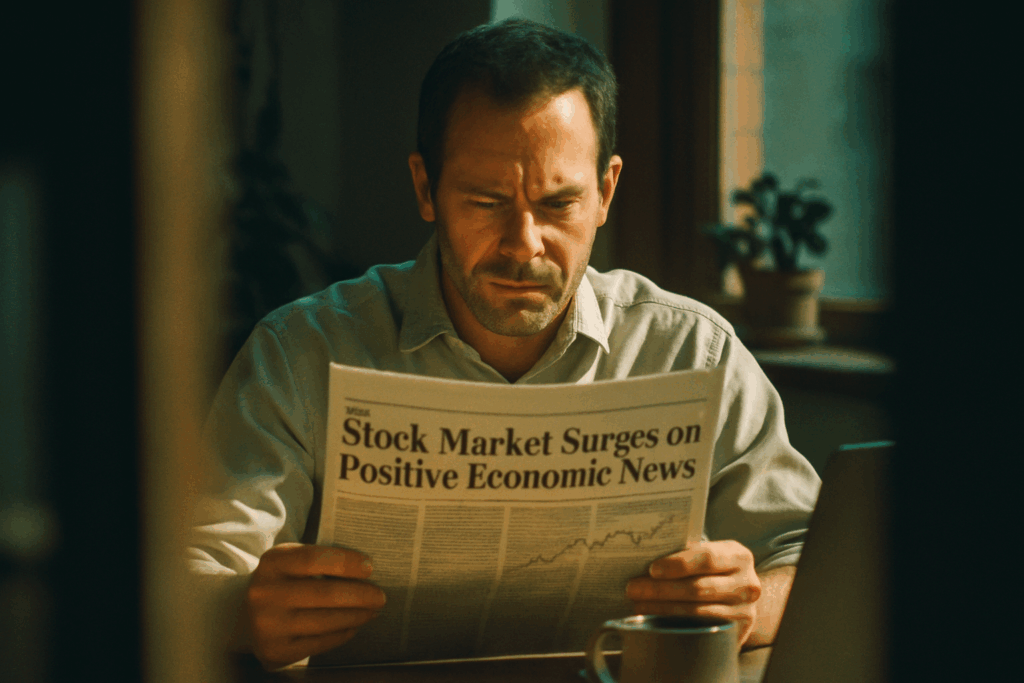

You followed the script. 401k. Index funds. Buy and hold.
And yet you still feel behind.
Like the rules changed while no one told you.
I felt that too. Then I stopped listening to the script.
This isn’t another list of “hot” assets or a rehash of what you’ve heard since 2008.
It’s the Disfinancified Financial Guide From Disquantified. Built from first principles, not headlines.
I tested every idea here against real data. Not theory. Not hope.
You’ll walk away with a new way to think about money (not) just what to buy, but how to judge it.
Plus a short list of asset classes most people ignore (but shouldn’t).
No fluff. No hype. Just clarity.
You’re tired of generic advice.
So am I.
Let’s fix that.
Why Your 60/40 Portfolio Feels Like a Broken Compass
I tried using a 1980 road map to drive through downtown Austin last week. Got lost in three minutes. That’s what the old financial playbook feels like now.
The 60/40 stock-bond split isn’t broken. It’s obsolete. Like dial-up in a fiber-optic world.
Inflation didn’t spike and fade. It stuck around. And bonds (the) “safe” half of that portfolio.
Got hammered. Real returns turned negative. You held cash?
Over the last decade, $10,000 lost 23% of its purchasing power (BLS CPI data, 2014 (2024).) Not theoretical. Not “on paper.” You paid more for milk, rent, and insulin.
Technology isn’t just changing how we work. It’s rewriting where value lives. A single AI model can replace teams.
A protocol onchain can settle trades faster than Wall Street clearinghouses. That changes what “assets” even mean.
And your career path? Gone. You’re not climbing one ladder.
You’re juggling gigs, equity, royalties, and side projects. That’s a portfolio career. Your finances have to match it.
The Disfinancified guide doesn’t push crypto or use. It maps real options (income) streams, asset classes that hedge inflation, structures that align with how people actually earn and live today.
So when people call alternative strategies “risky,” I laugh. Risky is pretending nothing changed.
This isn’t speculation. It’s adaptation.
You don’t need more discipline. You need different tools.
Cash isn’t safe. Bonds aren’t stable. And “diversification” means something new now.
What worked for your parents won’t protect your kids.
You already know this.
So why keep pretending?
The Disfinancified Financial Guide From Disquantified starts there (with) honesty, not hope.
A New System: Spotting Real Disquantified Wins
I don’t trust ROI alone. It’s lazy math. And it’s why most people miss the actual opportunities.
So I built a three-part filter. Not for spreadsheets. For judgment.
Asymmetric upside is step one. Ask: What’s the worst that happens? Then ask: What explodes if it works?
A $5,000 angel bet in a tiny SaaS tool could return 100x. A blue-chip stock won’t.
You know this. You’ve felt it.
Control matters more than you admit. If you can tweak pricing, fire a vendor, or pivot the offer. That’s use.
A niche newsletter? You own the list and the voice. A local rental?
You choose the tenant, the paint color, the lease terms. No board votes. No quarterly reports.
Just you and the outcome.
Scarcity isn’t about “limited edition.”
It’s about inherent limits. Bitcoin has 21 million caps. A Picasso has one original.
Sneakers get re-released. Art doesn’t. Code doesn’t.
Land doesn’t. Manufactured scarcity fades. Real scarcity compounds.
I go into much more detail on this in Disfinancified Financial Advice.
This isn’t theory. I’ve watched people chase “hot” digital assets with no real cap (then) lose half their money when supply flooded the market. Meanwhile, others slowly held early Bitcoin or bought a single undervalued building downtown.
One group guessed. The other knew the rules.
The Disfinancified Financial Guide From Disquantified lays this out cleanly. No fluff, no jargon, just the system I use every day.
You don’t need permission to apply this. You just need to stop treating all investments like they’re the same. They’re not.
And pretending they are? That’s how you stay broke while watching others compound slowly.
Three Weird Assets That Actually Pay You

I bought a niche recipe blog last year. Not for traffic. For the $1,200/month in ad revenue it throws off while I sleep.
That’s Acquiring Small, Profitable Digital Assets. A WordPress site. A micro-SaaS with 87 paying users.
A Telegram channel with 12,000 engaged followers. These aren’t “startups.” They’re cash-flowing machines you can buy outright (no) board meetings, no equity splits.
You control the pricing. You decide when to sell. You fix the broken plugin yourself or pay $45 on Fiverr.
Most people think “digital asset” means NFTs. Nope. It means something that puts money in your bank account this month.
Fractional ownership of a 1967 Ferrari 275 GTB? Yes, that’s real. Platforms like Rally and Masterworks let you buy slices of rare cars, vintage watches, even Stradivarius violins.
Scarcity isn’t theoretical here. There are only 320 of those Ferraris left alive. And you don’t need $3 million to own part of one.
But be honest. Do you actually want to deal with insurance, storage, and import paperwork for a $2.4M car?
Private credit is where things get quiet. Lend money directly to small businesses or real estate developers. Get paid back with interest.
Usually 8–12%. On a fixed schedule.
No stock ticker. No CNBC panic. Just a contract, monthly deposits, and your name on a loan note.
It’s not sexy. But it works.
The Disfinancified Financial Guide From Disquantified covers this exact setup (how) to vet deals, spot red flags, and avoid platforms that vanish after six months.
Disfinancified Financial Advice by Disquantified
I’ve lost money on crypto. I’ve watched REITs crater. But private credit?
Still paying me every 30 days.
Would you rather chase hype. Or collect checks?
Start small. Pick one. Then do it again.
Risk Isn’t a Buzzword (It’s) Your Money
Alternative assets scare people. I get it. You hear “private credit” or “farmland tokens” and think: Is this just gambling with extra steps?
It doesn’t have to be.
‘Alternative’ doesn’t mean reckless.
It means intentional.
Here’s what I actually do:
The 5% Rule. No single alternative holding exceeds 5% of my total portfolio. Ever.
If it’s not diversified across alternatives, you’re just swapping one risk for another.
And before I touch a dollar? I spend 10 hours learning for every $1,000 I plan to invest. Not skimming headlines.
Not watching TikTok explainers. Real research.
That discipline is why I trust my own decisions (even) when markets hiccup.
The Disfinancified Financial Guide From Disquantified helped me lock in that mindset early.
You’ll find the full system (no) fluff, no jargon (in) the Disfinancified guide.
Your Money Doesn’t Owe You Anything
The old financial guide is broken. You know it. You’ve felt it.
That tightness in your chest when the market dips, or when rent goes up again.
It leaves you stuck. Vulnerable. Like you’re just waiting for permission to be okay.
That ends now.
The Disfinancified Financial Guide From Disquantified gives you a real system. Not hope. Not hype.
A way to spot real alternatives. And judge them yourself.
Your first step isn’t to invest.
It’s to learn.
Pick one asset class from the guide. Spend 60 minutes this week researching it. That’s all.
No signup. No pitch. Just you and one hour.
You’ve spent years reacting.
This is where you start acting.
Go read. Then come back with questions. We’ll be here.
 There is a specific skill involved in explaining something clearly — one that is completely separate from actually knowing the subject. Kimberly Kayakenzor has both. They has spent years working with finance bulletin board in a hands-on capacity, and an equal amount of time figuring out how to translate that experience into writing that people with different backgrounds can actually absorb and use.
Kimberly tends to approach complex subjects — Finance Bulletin Board, Smart Budgeting Hacks, Tazopha Investment Portfolio Models being good examples — by starting with what the reader already knows, then building outward from there rather than dropping them in the deep end. It sounds like a small thing. In practice it makes a significant difference in whether someone finishes the article or abandons it halfway through. They is also good at knowing when to stop — a surprisingly underrated skill. Some writers bury useful information under so many caveats and qualifications that the point disappears. Kimberly knows where the point is and gets there without too many detours.
The practical effect of all this is that people who read Kimberly's work tend to come away actually capable of doing something with it. Not just vaguely informed — actually capable. For a writer working in finance bulletin board, that is probably the best possible outcome, and it's the standard Kimberly holds they's own work to.
There is a specific skill involved in explaining something clearly — one that is completely separate from actually knowing the subject. Kimberly Kayakenzor has both. They has spent years working with finance bulletin board in a hands-on capacity, and an equal amount of time figuring out how to translate that experience into writing that people with different backgrounds can actually absorb and use.
Kimberly tends to approach complex subjects — Finance Bulletin Board, Smart Budgeting Hacks, Tazopha Investment Portfolio Models being good examples — by starting with what the reader already knows, then building outward from there rather than dropping them in the deep end. It sounds like a small thing. In practice it makes a significant difference in whether someone finishes the article or abandons it halfway through. They is also good at knowing when to stop — a surprisingly underrated skill. Some writers bury useful information under so many caveats and qualifications that the point disappears. Kimberly knows where the point is and gets there without too many detours.
The practical effect of all this is that people who read Kimberly's work tend to come away actually capable of doing something with it. Not just vaguely informed — actually capable. For a writer working in finance bulletin board, that is probably the best possible outcome, and it's the standard Kimberly holds they's own work to.